Most people assume “private” on a rehab website means better. Nicer rooms, smarter clinicians, a shot at actually staying sober. Sometimes that’s true. Often it’s just a bigger invoice.
So here’s the plain answer. Private rehab in Indiana is addiction treatment run outside the state-funded system and paid for by commercial insurance, out-of-pocket money, or both. It typically covers some mix of medical detox, residential care, outpatient programs, and sober living. Expect roughly $1,700 on the low end for basic outpatient work and $6,000 to $20,000 for a 30-day residential stay, with dual-diagnosis programs climbing past that.
Key Takeaways
- Private means privately run and usually privately paid. It does not guarantee better clinical care, so ask what the price actually buys.
- Costs swing wildly by level of care. Detox is billed by the day, residential by the month, and outpatient by the program.
- Verify your insurance benefits before you tour anything. A benefits check takes a phone call and can save thousands of dollars.
How much does private addiction treatment cost, and does private mean better care?
Question: How much does private addiction treatment cost, and does private mean better care?
Answer: Private addiction treatment typically means a privately operated facility, often paid for through insurance or out-of-pocket. Costs vary by level of care, with detox generally billed by the day, residential treatment by the month, and outpatient care by the program.
Private treatment does not automatically mean better clinical care, so ask about services, staff credentials, and what the quoted price includes. Before choosing a facility, verify your insurance benefits and any out-of-pocket expenses to understand your options better.
What “Private Rehab” Means: Privately Run, Privately Paid, or Both
Two things hide inside that one word. A facility can be privately run, meaning a company or nonprofit board owns it rather than the county or state. And a patient can be privately paying, meaning commercial insurance or cash rather than Medicaid or a grant.
Most private rehab centers do both. Some privately run places also take state money for a handful of beds, which muddies things.
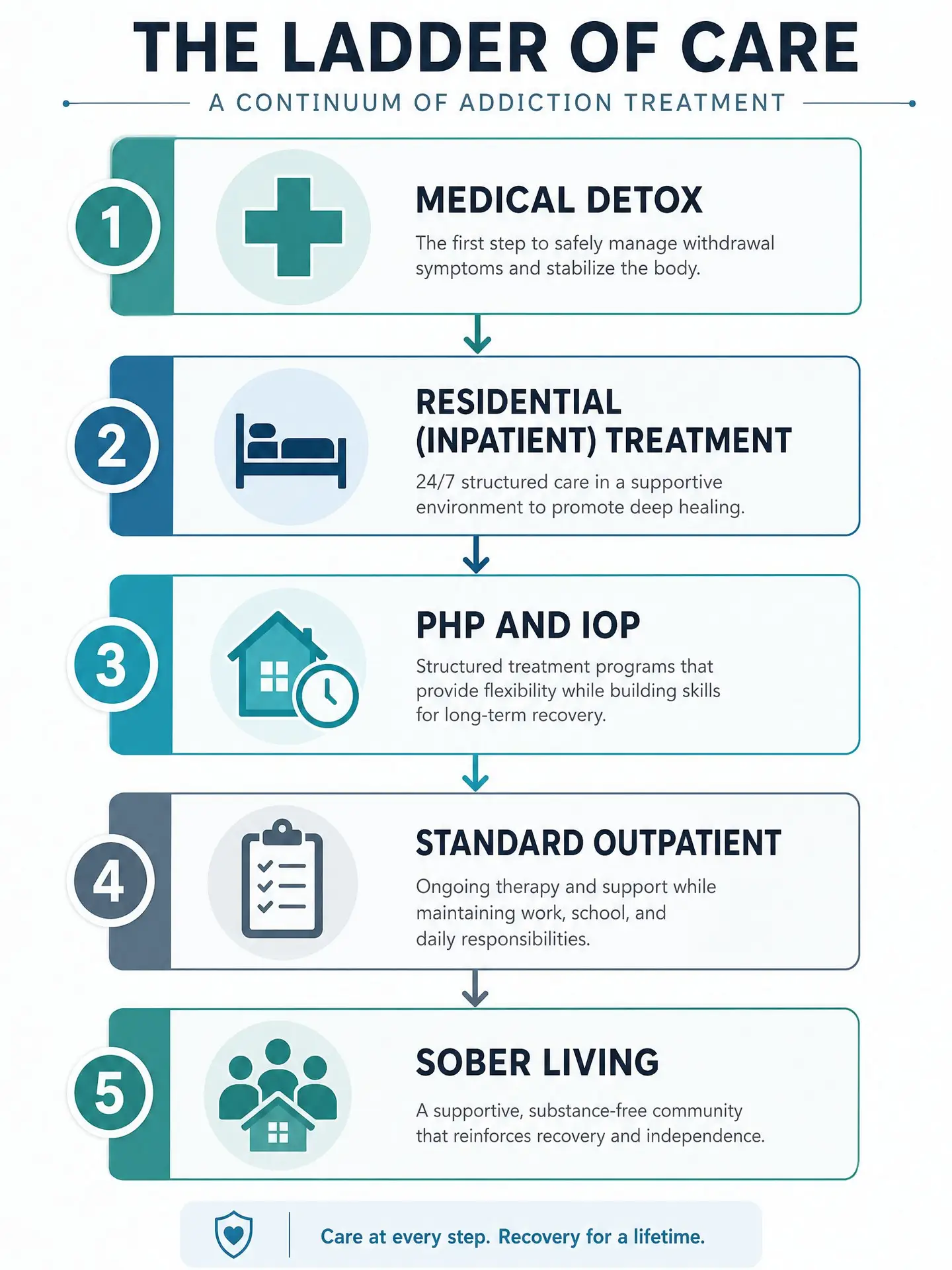
What do you get for your money? The ladder of care usually looks like this. Medical detox comes first, where clinicians manage withdrawal from alcohol, opioids, or benzodiazepines, the ones that can genuinely be dangerous without supervision. Then residential (inpatient) treatment, with daily therapy, medication management, and round-the-clock staff. Then partial hospitalization and intensive outpatient (IOP), where you sleep at home but spend several hours a day in treatment. Then standard outpatient, and finally sober living, which is housing with rules and peers, not clinical care. MedlinePlus lays out how residential and partial hospitalization structures differ if you want a neutral baseline.
Amenities are where private programs love to show off. Private rooms, chef-prepared meals, yoga, equine therapy, a campus that looks like a boutique hotel.
I’ll say it bluntly: a high price tag proves nothing about quality. One thread I read on body brokers described patients being sold to the highest bidder and bounced through 30-day programs that didn’t work. That isn’t treatment I’d pay premium money for. And inpatient isn’t automatically a relaxing reset either. One person in that discussion was ten days in and miserable. A fancy building doesn’t change what withdrawal and early recovery feel like.
Private Drug Rehab vs. State-Funded Programs: Wait Times, Staffing and Setting
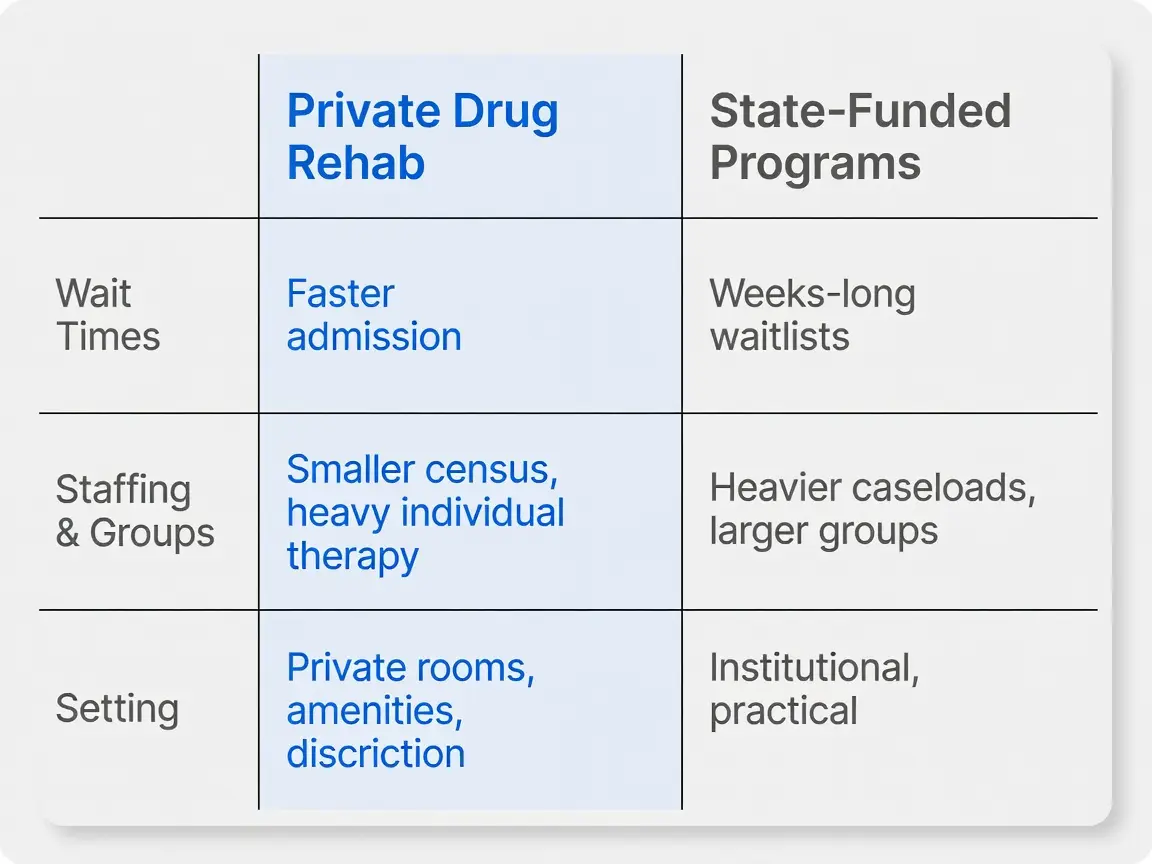
Public programs in Indiana do real, necessary work, and they’re often the only door open for people without coverage. Funding typically flows through federal block grants, which this state funding overview explains for partial residential, PHP, and detox services.
The trade-offs are practical, not moral. State-funded beds tend to carry waitlists, sometimes weeks, and that gap is dangerous when someone finally says “yes, I’ll go.” Caseloads run heavier. Group sessions run larger. Settings are often more institutional.
Private drug rehab generally offers faster admission, smaller census, more individual therapy hours, and more say over your room and schedule. That matters for people who can’t vanish from work for months, or who need privacy because of their profession. (If you’re a nurse, attorney, or executive, discretion isn’t vanity, it’s license protection.) FMLA can protect your job during treatment in many cases, so ask HR before assuming you have to quit.
The need isn’t small, either. Indiana’s state drug fact sheet tracks alcohol, opioid, and stimulant misuse across the state, and national data show opioid use disorder diagnoses climbing about 33% in three years. Demand is why waitlists exist.
Private Pay Rehab: How Self-Pay Works and Why Some People Choose It
Private pay rehab means you cover the bill yourself, with no insurer approving each day of care. Why would anyone choose that when they have coverage?
Control, mostly. Insurers use utilization review, which is a polite phrase for “we’ll decide when you’ve had enough.” Some plans authorize ten days of residential, then push you down to IOP whether or not you’re ready. Self-pay lets the clinical team and you set the length of stay. Others pay cash for privacy, because claims create records employers and plan administrators may see.
Here’s the rough pricing, pulled from several Indiana and national sources. Treat the numbers as ballparks, not quotes.
| Level of care | Typical range | What moves the price |
|---|---|---|
| Medical detox | $200 to $600 per day for alcohol, $200 to $500 per day for opioids (Clear Cost Recovery) | Substance, medical complications, length of stay |
| Residential (30 days) | $6,000 to $20,000 (Red Ribbon Recovery); dual-diagnosis often $10,000 to $30,000 per month (Addiction Resource) | Room type, staffing ratio, mental health care |
| Outpatient / IOP | Averages near $1,706 for basic outpatient; fuller programs run $5,000 to $10,000 | Hours per week, program length |
| Sober living | Usually a few hundred to under $2,000 a month (my rough estimate, varies widely) | Location, amenities, support services |
National figures line up, with one benchmark putting medical detox entry near $1,750 and monthly inpatient starting around $6,000.
Now the part I care about most. Before paying, ask exactly what the price buys. Medical detox? Ongoing treatment with licensed therapists? Or a polished 30-day stay followed by “come back for another month”? Research from the National Institute on Drug Abuse has long pointed to about 90 days as the threshold for meaningful results, as laid out in its treatment principles. A 30-day block with no step-down plan is a starting line, not a finish. I wouldn’t pay extra for luxury branding while the real plan is repeat admissions. If a place can’t explain its pricing in plain English, walk.
What Commercial Insurance Usually Covers at Private Rehab Centers
Federal parity rules say plans offering mental health and substance use benefits can’t make them harder to use than medical benefits. In practice? Messy. Coverage depends on the plan, the network, and what the insurer deems medically necessary.
Commercial insurance providers commonly cover detox, residential, PHP, IOP, and medication for addiction treatment, though often with prior authorization. Your out-of-pocket exposure comes from deductibles, coinsurance, and whether the facility is in-network. Out-of-network can still pay something, just less. Indiana residents with complaints about denials can start with the Indiana Department of Insurance, which handles consumer rights around parity.
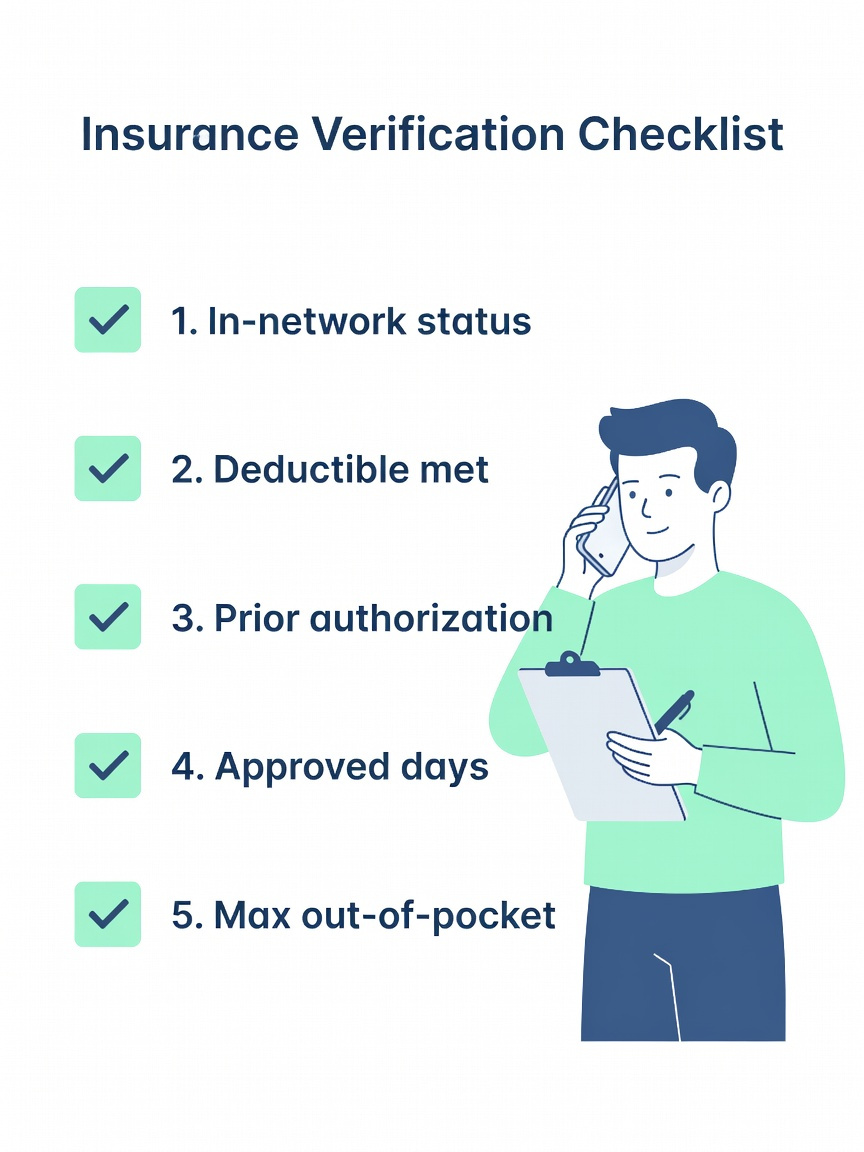
Verifying benefits comes down to a handful of questions:
- Is the facility in-network for my specific plan?
- What’s my deductible, and how much of it is met?
- Which levels of care need prior authorization?
- How many days are approved at each level?
- What’s my maximum out-of-pocket for the year?
Ask for answers in writing. Phone promises evaporate.
How to Compare Rehab Centers in Indiana: A Short Checklist
People type “best rehabs in Indiana” into search all the time, and I get it. But “best” depends on who’s asking. The best fit for a 28-year-old with opioid dependence differs from the best fit for a 55-year-old with alcohol use disorder and depression.
Whether you’re searching rehab centers in Indiana from your couch at 2 a.m. or scrolling “private rehab near me” in a parking lot, check these:
- Licensing and accreditation. Confirm through the state and the SAMHSA treatment locator.
- Medical staff on site, especially for detox.
- Evidence-based therapy (CBT, DBT, medication-assisted treatment), not just “wellness.”
- Dual-diagnosis capability if anxiety, trauma, or depression travel with the addiction.
- A written aftercare plan before discharge.
- Transparent pricing, including what’s extra.
Any rehab center in Indiana that dodges these questions is telling you something. Listen.
Admissions and Same-Week Availability
Good admissions teams do three things quickly: verify benefits, run a clinical screening, and arrange arrival, sometimes the same week. Speed matters because motivation is perishable. The person who says yes on Tuesday may say “I’m fine” by Friday.
Expect a phone assessment covering substance use history, medical issues, medications, and mental health. Then a benefits check. Then logistics, like travel and what to pack. Indiana rehab centers with real availability will tell you so directly. If you hear “we’ll call you back next month,” that’s a waitlist wearing a nice suit.
Conclusion
Private treatment buys access, speed, comfort, and control. It doesn’t buy results on its own. Judge programs by what they deliver (medical safety, evidence-based therapy, a plan beyond day 30) and not by the thread count of the sheets.
Ready to see what your coverage actually pays for? Verify your insurance or ask about private-pay rates with First City Recovery Center private rehab, and get real answers before you commit a dollar.
Frequently Asked Questions
How much does private rehab cost in Indiana?
Roughly $1,700 to $10,000 for outpatient, $6,000 to $20,000 for 30 days of residential, and $10,000 to $30,000 monthly for dual-diagnosis programs. Detox adds $200 to $600 per day.
Does insurance cover private drug rehab?
Most commercial plans cover some levels of care, often with prior authorization and network limits. Verify benefits before admission.
What’s the difference between private rehab and state-funded rehab?
Private programs usually offer faster admission, smaller groups, and more amenities. State-funded programs serve people with limited means but often carry waitlists.
Is private pay rehab ever the better choice?
It can be, when you want control over length of stay or privacy from insurer records. Confirm the facility accepts self-pay and ask for a written rate sheet.
How long should treatment last?
Research points to about 90 days as the minimum for lasting benefit, though that can include step-down care like IOP and sober living.