
You know you need help. You also have a company, a caseload, a trading desk, a surgical schedule, or forty employees who think you have it together. That tension stops more people from getting treated than any lack of options does.
So let’s be plain about executive rehab. It isn’t a separate branch of addiction medicine. The clinical backbone should look like any good substance use treatment. What changes is the scaffolding around it: privacy, scheduling, communication rules, and a real plan for walking back into your job. That’s the whole pitch of rehab for executives, and it’s the part worth paying attention to.
Key Takeaways:
- Executive rehab should be quality executive addiction treatment first. Privacy, device policies, and re-entry planning are what make it executive.
- Length of care and aftercare matter far more than a private room or a chef’s menu.
- Never assume anything about confidentiality or work access. Get the specifics in writing.
Is executive rehab worth it?
Question: Is executive rehab worth it?
Answer: Sometimes. If the structure around treatment is what keeps you from showing up at all (discretion, flexible communication, a serious return-to-work plan), it can be worth every dollar. If you’re mostly paying for a nicer building, no. Judge the clinical team and the discharge plan, not the lobby.
What Executive Rehab is, And Who it is Built for
“Executive” doesn’t mean CEO. Rehab for executives can be relevant to physicians, attorneys, founders, finance professionals, senior managers, business owners, and public-facing professionals anyone whose absence, privacy, or professional responsibilities carry real consequences.
Founders. Surgeons. Attorneys. Pilots. Sales VPs who close deals on a Tuesday night over a fourth bourbon. These are the people who show up, because their addiction doesn’t look like the movie version. They pay the mortgage and hit the quarterly numbers, and the problem hides inside competence.
The need is bigger than most people assume. The SAMHSA national survey estimates well over 54 million Americans aged 12 and older needed substance use treatment in a recent year, and only a small share received it. A lot of the missing ones are working professionals who figured they’d handle it themselves.
And spouses. Often the first search comes from a husband, wife, or business partner, not the executive. If that’s you, know that someone in this position rarely says yes on the first conversation. Plan for the third.
That’s where executive rehab centers and executive drug rehab centers can provide a more tailored treatment environment. Depending on the individual’s needs, rehab for executives, executive rehab near me, executive drug rehab, executive alcohol rehab, or executive detox may combine appropriate clinical care with greater attention to privacy, professional responsibilities, communication, and returning to work.
If you’re searching for executive rehab near me, remember that the goal isn’t simply to find the most luxurious facility. The right program should provide appropriate addiction treatment while addressing the practical barriers that may make it difficult for a working professional to step away from their responsibilities.
In simple terms: Executive rehab is addiction treatment designed to address both the clinical needs of the patient and the practical demands of a high-responsibility professional life.
It’s also worth dropping the “high-functioning” label. Work performance tells you very little about the severity of a substance-use problem. Someone can continue meeting targets, leading a company, or treating patients while their alcohol or drug use is becoming increasingly dangerous at home or behind the scenes.
Executive vs. Standard Rehab: Where the Real Differences Sit

Here’s the comparison I’d want in front of me. Features vary by provider, so treat it as a map of what to verify, not a promise.
| Area | Standard treatment | Executive-focused treatment |
|---|---|---|
| Privacy | Standard clinical confidentiality | Extra operational discretion (admissions, visitors, room setup) |
| Work | Often a full separation | Structured conversation about responsibilities |
| Devices | Frequently restricted | Program-specific phone and laptop policies |
| Accommodation | Shared or private, varies | Private rooms often available |
| Re-entry | Standard discharge planning | Heavier focus on returning to demanding work |
| Professional concerns | Rarely central | Licensing, leadership, and reputation addressed |
Notice what’s missing. Nothing in that table says the therapy is better. Some third-party summaries claim executive programs hit success rates as high as 75% against roughly 41% for standard 30-day stays. I’d treat that number with suspicion, since it traces back to provider marketing, not independent trials. But the gap it hints at probably has a boring explanation: longer stays.
And that lines up with the science. The NIDA principles of treatment guide says stays under about 90 days are of limited effectiveness for many people, and that individualized, longer-term care does better. So the 45 to 90 day window common in executive programs is the valuable part. The executive chef is a side dish.
What Happens During Executive Rehab, Step by Step
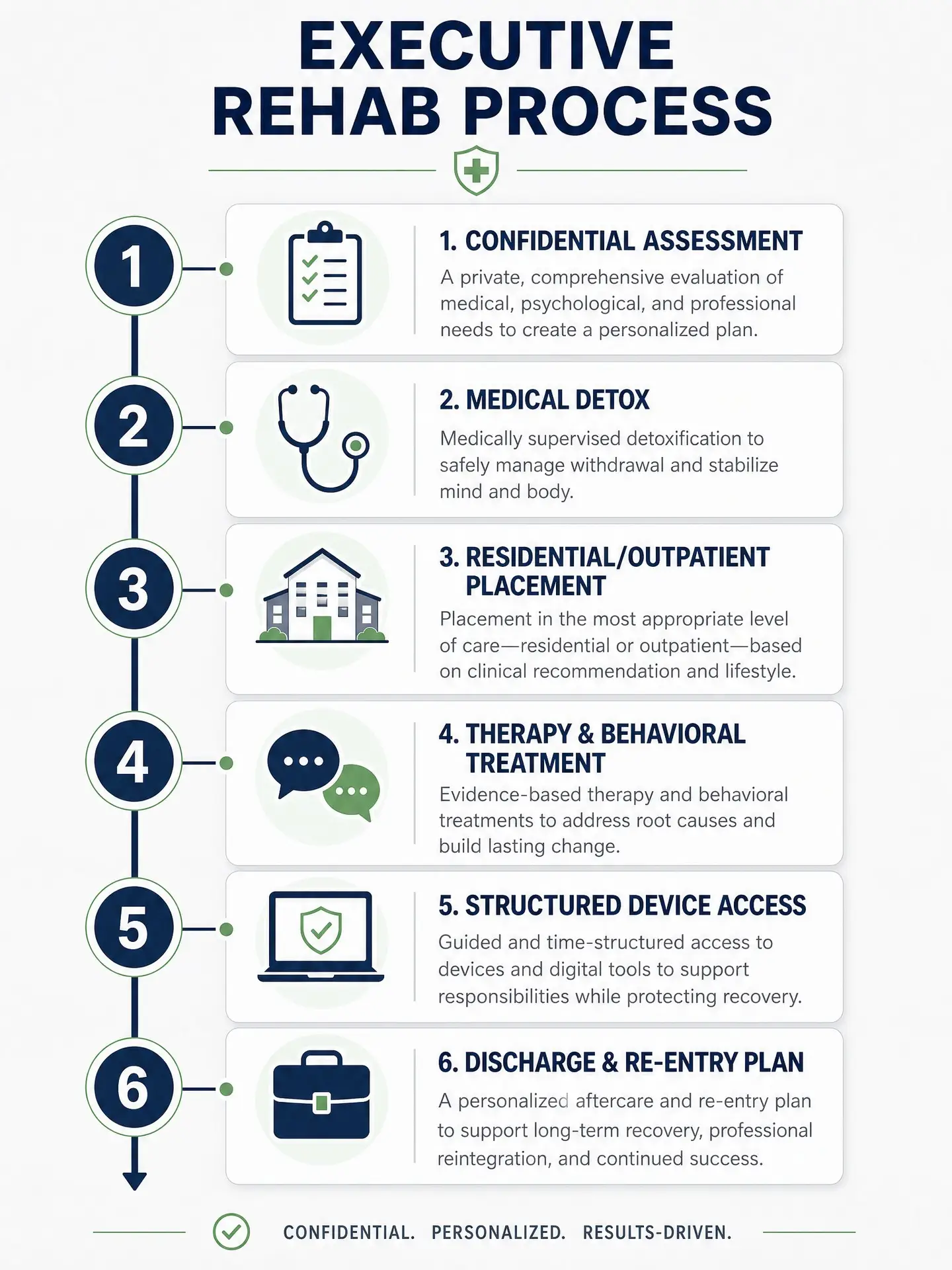
Confidential assessment and admission
Before anything else, a clinician sorts out what you actually need. That means substance history, how often and how much, past attempts to quit, withdrawal history, medications, sleep, mental health, and your work and family situation. The point of assessment is matching you to a level of care, not funneling every executive into a residential bed.
Have these ready:
- A rough timeline of use, including the last 30 days
- Every prescription and supplement you take
- Past withdrawal symptoms, seizures, or ER visits
- Any therapy or diagnoses already on record
- Your work calendar for the next two to three months
Medical detox, if needed
Detox and rehab aren’t the same. Detox is medically supervised withdrawal management, and it’s only the doorway.
Medical safety note: Stopping heavy alcohol or sedative use abruptly can be dangerous, even life-threatening. Don’t white-knuckle it alone. Get a medical assessment first.
Whether you need supervision depends on the substance, your pattern of use, your health, and your withdrawal history. A rehab directory analysis of how facilities report withdrawal services shows how uneven this can be, so ask a program directly what medical coverage exists on site, and when.
Residential or outpatient
Level of care should follow clinical need, safety, home stability, and support, not job title or income. Here’s the quick version.
| Setting | Typical fit |
|---|---|
| Residential / inpatient | Higher withdrawal risk, unstable home, repeated failed attempts |
| Partial hospitalization / intensive outpatient | Stable home, needs structure several days a week |
| Standard outpatient | Milder use, strong supports, step-down after residential |
Plenty of working professionals do well in intensive outpatient treatment. Others really do need to step out. An honest clinician will tell you which, even when the pricier option would be easier to sell.
Therapy and behavioral treatment
This is what you’re really paying for. Individual therapy, group therapy, family sessions, CBT, relapse-prevention planning, and screening for co-occurring conditions like anxiety, depression, or trauma. A good team also digs into triggers specific to your life: travel, client dinners, the 9 p.m. inbox, a workplace culture that rewards the person who drinks last.
Careful, though. Executive stress doesn’t “cause” addiction. What treatment can do is examine how pressure, coping habits, and substance use got tangled up together.
Phone and laptop access
Policies run from strict no-device rules to structured daily windows for email and calls. Ask who decides what’s clinically appropriate, whether devices are allowed during therapy, and how a true business emergency gets handled.
Don’t assume. The phrase “executive rehab” guarantees nothing about devices.
Honestly, I’m wary of the pitch that you can run your company from a treatment bed. Keeping up every work habit can turn rehab into one more way to dodge the stepping-away that treatment needs.
Discharge, aftercare, and returning to work
Recovery doesn’t end at discharge. It starts there. A credible plan covers ongoing therapy, peer support, medication management when appropriate, a relapse-prevention plan, family involvement, follow-up appointments, and a crisis plan. It should also name your riskiest work situations out loud, such as the conference circuit or the board dinner, and rehearse them.
Before you go back, check that you have:
- A phased schedule, not a full-speed Monday
- A named clinician and standing appointments
- A script for what colleagues are told
- A plan for travel and entertaining
How Confidential Is Executive Rehab?

Mostly, but not absolutely, and no honest provider will claim otherwise.
In the U.S., treatment records fall under HIPAA, and substance use treatment records get an extra layer of protection under federal rules (42 CFR Part 2). Providers generally need your written consent to share information with your employer or family, with narrow legal exceptions such as medical emergencies or court orders.
The leaks tend to happen elsewhere: billing statements, insurance explanations of benefits, an unplanned visitor, an assistant who scheduled your calendar block. Ask about all of it.
Questions worth asking:
- Who exactly can see my records, and under what circumstances can information be disclosed?
- What will you say if my employer calls?
- How do you document my communication preferences?
- Are admissions and room assignments discreet?
- What are your visitor policies?
- How does insurance billing appear on statements?
- Can I pay privately, and what record does that create?
Speaking with a specialist before deciding is a low-stakes first move, and a good provider will answer every one of these without flinching.
Can Executives Keep Working in Rehab?
There’s no universal answer. Some programs allow limited professional contact; others deliberately build a wall. The call should rest on your clinical needs, not your calendar.
Separate two things: essential continuity (signing a payroll approval, answering a true emergency) and running the business as usual. The first is manageable. The second usually defeats the purpose.
Handle this before admission. Delegate operational duties, name a backup decision-maker, and set up an emergency contact path. Licensed professionals such as physicians, attorneys, and pilots may have regulatory obligations, so get separate advice from your licensing board or counsel.
Choosing a Program
Skip the brochure and check these:
- Can they safely handle your substance use disorder, including detox or a clean referral?
- Is the clinical team credentialed, with addiction medicine, mental health, and nursing coverage?
- Is the assessment individualized or one-size-fits-all?
- Can they explain why they use each therapy?
- Do they treat dual diagnosis?
- Are confidentiality and device policies in writing?
- Is there a real aftercare plan?
- Do they support your profession, such as monitoring programs for licensed clinicians?
- Are costs and insurance accepted terms clear, including what isn’t covered?
- Is the facility licensed and accredited?
The SAMHSA N-SSATS census shows treatment facilities split roughly between private nonprofit (about half) and private for-profit (about four in ten) ownership, so ownership alone tells you little. The national survey overview explains how these facilities get cataloged, which helps when you’re checking that a program is real and licensed. Also, if you’re searching “executive rehab Indiana” or anywhere else local, remember geography matters mostly for family involvement and aftercare, not prestige.
One more view, which is mine. I’d judge a place by its clinical care and what happens after discharge, not the menu. When a counselor pitches private rooms, an executive chef, and a longer stay because it’s out-of-network, you’ve learned exactly what’s being sold: comfort and time. Pay for the time and the follow-up. Don’t mistake the chef for treatment.
What Executive Rehab Should Not Be
Luxury rehab typically focuses on comfort, privacy, upscale accommodations, and amenities such as private rooms, chef-prepared meals, fitness facilities, or concierge-style services. These features can make treatment more comfortable, but they don’t necessarily mean better clinical care.
should go further than simply offering a luxury setting. For professionals researching executive rehab in Indiana or luxury rehab Indiana, the right program should address practical challenges such as privacy, work responsibilities, communication, and returning to work while keeping addiction treatment at the center.
Red flags include:
- A luxury hotel with limited clinical or medical support.
- “Work whenever you want” policies with no therapeutic boundaries.
- Promises of career protection or guaranteed recovery.
- Claims of absolute confidentiality beyond applicable legal protections.
- A “quick cure” approach focused on detox without long-term recovery planning.
- Avoiding difficult conversations about substance use, family, behavior, or mental health.
- Selling amenities as a substitute for qualified clinical care.
The executive component should remove practical barriers to treatment not replace treatment. When comparing programs, look at clinical expertise, treatment methods, medical support, mental-health care, and aftercare first. Then consider privacy, accommodations, work-related flexibility, facility features, insurance options, and location.
Considering Executive Rehab in Indiana?
If you’re searching for executive rehab near me, First City Recovery Center provides addiction treatment in Kokomo, Indiana, about 35 miles north of Indianapolis. Its Indiana locations include 317 W. Jefferson Street and 310 W. Taylor Street in Kokomo.
First City Recovery Center offers a continuum of care that includes medical detox, residential treatment, partial hospitalization (PHP), intensive outpatient (IOP), and outpatient treatment. The Joint Commission’s provider directory also lists First City Recovery Centers as accredited for substance-use-disorder services, including medically managed residential services, high-intensity residential care, PHP, IOP, and outpatient therapy.
Indiana’s Division of Mental Health and Addiction also lists First City Recovery Centers LLC locations in Kokomo as active ASAM-certified residential providers.
For insurance, First City says it works with most commercial insurance policies and lists providers including UnitedHealthcare, Anthem, Cigna, Magellan, Beacon, TRICARE, VA Community Care, Humana, and Aetna. Coverage can change, so verification is recommended before admission.
For professionals considering treatment, it’s worth asking directly about executive accommodations, privacy procedures, phone and laptop policies, work communication, and facility amenities, as these details can vary by program and level of care.
Ready to explore treatment? Contact First City Recovery Center at (406) 637-7766 for a confidential discussion about executive rehab, treatment options, insurance verification, and admissions.
Confidentiality, Your Employer, and Your Professional License
Substance use treatment records get stronger protection than ordinary medical files under federal rule 42 CFR Part 2, layered on top of HIPAA. The HHS consumer guidance on HIPAA is a decent place to understand what a facility can and can’t disclose without your written consent.
Practically: nobody calls your employer unless you sign off. Your cover story, if you need one, is your decision. Medical leave under FMLA may apply if you’ve been with an employer long enough, though you should talk to HR counsel before you assume.
Licensed professionals (physicians, attorneys, pilots, financial advisors) have a different wrinkle. Boards often treat voluntary treatment far more kindly than discovered impairment. Many states run confidential monitoring or peer-assistance programs for exactly this reason. Getting help early is almost always the safer career move.
Taking the Next Step
Asking for help when people depend on you can feel complicated. But seeking treatment is a clinical decision, not a professional failure.
Start with a confidential assessment, then ask about clinical fit, privacy, work policies, and aftercare before choosing a program. If you or someone you love is in immediate medical danger, call 911 or 988 rather than completing an admissions form.
When you’re ready, First City Recovery Center executive rehab can help you explore drug and alcohol treatment for professionals in a confidential, no-pressure conversation.
Frequently Asked Questions
Is executive rehab different from regular rehab?
The clinical foundation should be the same: appropriate, evidence-based addiction treatment. Differences usually lie in privacy, work policies, communication access, accommodations, and professional re-entry planning.
Can I keep working during executive rehab?
It depends on the program. Some allow limited, structured contact, and others require a firm separation. Work access should always be balanced against what your treatment needs.
Will my employer know I went to rehab?
Not automatically. Privacy laws and consent rules protect your records, but billing, insurance, schedules, and workplace requirements can still create trails. Ask each provider exactly how they handle disclosure.
How long does executive rehab take?
There’s no fixed duration. Detox might take days, residential care often runs 30 to 90 days, and outpatient care and aftercare can continue for months or longer.
Does executive rehab guarantee recovery?
No treatment can promise that. Good programs offer individualized care, continued support, and a long-term recovery plan, and then you do the work.